Saturday, August 13, 2011

Tales of the Horseshoe


The month I turned 56, I had to accept the fact that I might never hear an Englishman brag about the size of Wembley stadium. I’d been hoping for this event to happen and had been waiting to point out that while Wembley can seat 90,000, Ohio Stadium can seat 102,329.The last time OSU had a football game that was not a sellout was in 1971.

Back in the olden days, OSU played its football games in Ohio Field, on Canfield and High, until Chic Harley made the Buckeyes such a popular team that a new facility was obviously called for. OSU president William Oxley Thompson declared the new stadium would have to be built in the floodplain next to the Olentangy River—he didn’t want it to tower over every other university building. That turned out to be the case to this very day. Ohio State’s Thompson Library (named for the president who made the decree), the 20th largest in the country, is on the top of a nearby hill sop it towers over the stadium. Almost a hundred years ago, the 100-yd dash was a popular sport, so originally, the stadium was built with one end open, making it a giant horseshoe. I recently amused myself by looking through old editorials insisting a stadium seating 61,110 would never be filled to capacity. How time proved them wrong. When I was a child capacity had expanded to 84,000, by the 90s it expanded to 95,000, and now it is over 100,000.

My readers from outside the US might wonder what would happen if Columbus ever got hit by a full-blown blizzard in late November and there were several inches of snow with a wind-chill factor of well below 0. That’s exactly what happened in 1950, when OSU played archrival Michigan in the late November Snow Ball. My advisor at OSU, Ray Hamilton, played in that game, and he is still none too happy about that outcome. OSU lost 9 to 3.

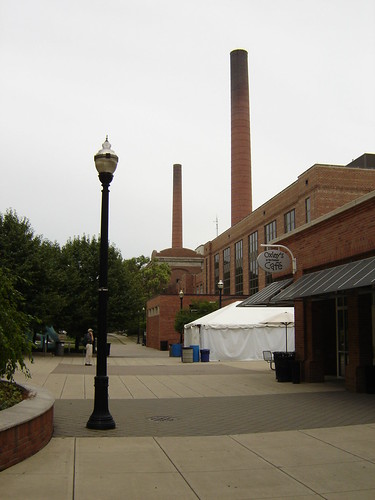
One of the more conspicuous features of the OSU campus is the power plant with two smokestacks at Neil and 17th. I haven’t measured them, but a utility worker told me they stand 250 ft high. One popular legend is that each was built to commemorate a virgin co-ed graduating from Ohio State.

Back in 1978, a cartoonist from the OSU newspaper the Lantern made another metaphorical use of those smokestacks. In August of that year, Pope Paul VI had died and there was endless TV coverage of the crowds gathered in St Peter’s Square awaiting the appearance of the white smoke announcing the election of another Pope. A month later, Pope John Paul I died and once again, there was endless coverage of the crowds watching for smoke again. Three months later, OSU’s legendary football coach Woody Hayes saw his career come to an ignominious end after 28 years when he was fired after the 1978 Gator Bowl. In a stroke of brilliance, the editorial cartoonist did a drawing of every sentient being in Columbus gathered around the stadium, staring up at the smokestacks, awaiting the appearance of white smoke to announce the election of a new football coach. After this last year’s pay-for-tattoos scandal, a young gentleman named Luke Fickel is going to discover he has a chance to be a monumental hero or a monumental goat. If he doesn’t know already, all OSU fans want (and expect) is constant perfection.

The Third Joe McCarthy


One aspect of my Apserger’s is that when I was younger I sometimes had difficulty grasping that two very different people could have the same name. This came to my staunchly democratic parents’ opinion when I opined I thought Joseph McCarthy had done a great job. After the EMTs revived my mother (OK, a slight exaggeration)…

To put it mildly, my parents were no great admirers of the one-time Republican senator from Wisconsin. I had been referring to the baseball player and manager Joe McCarthy who won a pennant for the Chicago Cubs in 1929, and seven pennants and six World Series titles for the Yankees 1936-1943. His record of managing seven world champions still stands, though he shares it with Casey Stengel.

I recently learned about a third Joseph McCarthy who is in my opinion one of the great unsung heroes of WWII. He enlisted in the royal Canadian Air Force in May of 1941 and became a Lancaster pilot. What made him truly extraordinary is that he was the only Yank serving in the legendary 617 Squadron, better known as the Dambusters. Their most famous mission came 1942 against three hydroelectric dams in the Ruhr Valley. They were carrying specially designed bombs. To hit the dams just right, they had to come in at 60 ft off the water, flying at speeds of upward to 200 miles per hour, in the dead of night with everyone and their second cousin trying to shoot you down. The bombs they carried were designed to spin backwards upon release, 5,000 bombs that would skip across the water until they would hit the dam, sink to the bottom, and then explode.

19 planes made the Ruhr Valley attack. Eleven of them made it home. They blew up three Ruhr dams. Squadron commander Guy Gibson received the Victoria Cross and a training job, though he kept volunteering for duty until he was put back in at the end of the war when he was killed.

McCarthy survived the mission, one of the few Yanks ever invited to tea at Buckingham Palace, where he received the Distinguished Service Order. Such was McCarthy’s skill and bravery that he made it back to Buckingham Palace on two other occasions to receive a Distinguished Flying Cross and a Repeat Bar (there is no truth to the rumor that on his third visit, the domestic staff asked “You again?”)

I was interested that unlike most Americans, McCarthy stuck with the RCAF not only for the duration of the war but until he retired in 1961. I doubt anyone ever questioned whether he’d earned his pension. I understand that pilot McCarthy died in 1997 at the age of 78. Seeing as he was around at the 50th anniversary of the Dambuster’s raid, I’d say he was playing with the House’s money.

My Report on Ted Lewis


When I was in 4th grade back in the 1964-65 school year, my teacher was a very fine lady named Mrs Abel. Mrs. Abel taught not only yours truly but all three of the other Mitchell bros, which proves to me that Mrs. A did not scare easy. Many years later I learned she taught for 42 years and went out “with her boots on”: she was teaching in the classroom until a week before she died.

All these years later I remember her as an extraordinarily fine teacher. She had us write reports that encouraged students to learn about research at a very tender age. I received an assignment to do a short report on band leader Ted Lewis ( 1892-1971) from Circleville Ohio. His trademark was the saying “Everybody happy” and whose biggest hit was “Me and My Shadow.” Once while passing thru Circleville I spied a small museum dedicated to his memory. What I did not find out until many years later is that though married, in his late 50s he took up with an aspiring actress 34 years his junior named Norma Jean Baker. As some of my readers might know, she later changed her name to Marylin Monroe. If only I’d known that back then, I could have made a much more interesting presentation.

George Patton on Opposing Viewpoints


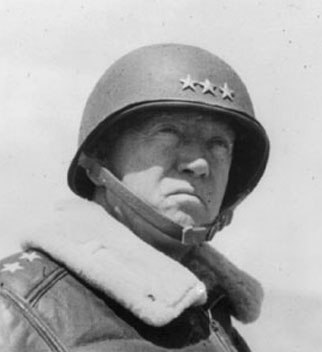
I’ve always admired the following quote from General George S Patton: “There are people who disagree with me… They are wrong.”

US Marshalls


In almost all great military powers, there is a rank above general called Field Marshall. The Soviets had Marshall Zhukov, the French had Marshall Paton, the Italians had Marshall Bagdolio, and the British had Field Marhsall Montgomery. The only great power that does not follow this tradition is the US. Reason is during WWII, when it became clear the US Army would require a rank above general, that rank certainly would have been bestowed upon Army’s highest-ranking officer, the Chief of Staff, who was then Goerge Marshall. He let it be known on no uncertain terms that he did not want the title of Marshall Marshall. He was given the title General of Army, a rank since discontinued. Ironically enough, the only American to attain the rank of Field Marshall was Douglas MacArthur, who before WWII accepted the title for the Filipino Army.

Ward Hill Lamon, Unsung Hero


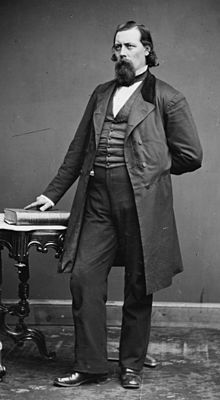
Ward Hill Lamon became a lawyer as a young man and got to be good friends with a rising Illinois politician almost twenty years his senior named Abaraham Lincoln. Lamon had the scholarship to be a lawyer. He also had the stature and personality to be an extremely formidable bodyguard. Apparently, he was one of the only men in the state who towered over Lincoln (who was 6’4”). Lamon did not share all of Lincoln’s political views (he had reservations about abolition), but when Lincoln became the president-elect, Lamon became Lincoln’s bodyguard en route to DC. ON the last leg of the trip from Springfield to Washington, only one man accompanied Lincoln, and that was Lamon, packing his suual two pistols, a bowie knife, and a blackjack. Lamon had originally hoped to be named to an ambassadorship, but Lincoln insisted on making Lamon the US Marshall for the District of Columbia.

Lamon frequently was quite literally on Lincoln’s side. On one occasion, some ill-intentioned southern sympathizer pretended to shake Lincoln’s hand, then tried to injure him by using a vice grip. Lincoln cried out in pain, Lamon cold-cocked the scoundrel. On another occasion, Lamon patrolled the White House grounds and found a suspicious character hiding in the White House shrubbery. The man made a suspicious move that turned out to be his last: Lamon hit the guy so hard he killed him. Later that evening, the Secret Service discovered the man was a southern sympathizer carrying pistols in his pockets.

Not everyone liked Lamon. Some contemporaries describe him as being self-important. But Lincoln’s secreatay reported being deeply touched when he looked down the White Housen hall to Lincoln’s bedroom the night he won re-election. Lamon was stretched out on the floor asleep. No doubt with two pistols close at hand. Ironically enough, in early April of 1865, Lincoln, sent Lamon on an errand to the recently captured Confederate capitol of Richmond, Virginia. Lamon’s last words to the President were a warning not to go out, especially not to the theater.

Lamon was a political ally to Lincoln as well as a physical protector, and he worked on Lincoln’s re-election campaign in 1864. Political songs were in vogue back then, and one verse went like this:

A great good man is Ward Hill Lamon;
Abe is Pythias; he is Damon;
He's the President's protector,
He's his political protector,
Who?
Ward Hill Lamon. Ward Hill Lamon.

German Pension Plans in Tanzania


Anyone who has seen either the African Queen or Out of Africa knows that during WWI, the fighting extended to The Dark Continent, where Britain, France, and Belgium helped themselves to the colonies Germany had set up in the 25 years after the Congress of Berlin. In an amazing fluke of history, the officer in charge of German East Africa (modern day Tanzania) happened to have an Army commander, Paul Von Lettow-Vorbeck, who turned out to be a singularly talented and tenacious leader. From the first day of the war he knew that he was completely on his own. He got almost no help from home in the entire war and with a force of 30 German officers, 100 NCOs, 1000 native troops and about 3000 porters, he launched a hit and run campaign against allied forces that frequently outnumbered him over 10 to 1. Few people thought that colony’s resistance would last more than a few weeks.

That campaign is just one more example of General Sherman’s statement that war is hell. The fighting devastated food production, led to widespread starvation, and when the Spanish Flu reached that part of Africa through 1918 and in 1919, it hit the European population hard and the African population even worse. Vorbeck did not lay down his arms until November 23, 1913, when he finally got word the Armistice had been signed 12 days earlier. Vorbeck and his men were the only German soldiers out of the millions of men who served in the Wehrmacht, were the only ones who got a victory parade when they went back to Berlin.

Back in Gemrnay, Vorceck was advanced from Lt Colonel to major general until he was forced into early retirement. Although not a professional politician, he was an excellent judge of character: he loathed Adolph Hitler from day 1. After the Fuhrer offered to make Vorbeck the ambassador to the Port of St James, Vorbeck indignantly refused. WWII was a terrible thing for the Vorbeck family. Both his sons were killed in the war, Vorbeck’s house was destroyed in a bombing raid and for the last years of the war, he lived in fear that the Gestapo surveillance he was subjected to might turn into arrest or execution. After 1945, Vorbeck’s family escaped starvation, ironically enough, by food parcels sent to him by his old adversary, South African Field Marshall Smuts. Vorbeck was blessed with extraordinary longevity. He lived into his nineties, outlasting the Nazis and even lived to see Tanzania become an independent country. In the last years of his life he was invited back to his old stomping grounds as a guest on a number of occasions.


There is one last PS to Vorbeck’s life which would make an excellent ending if they ever make a movie about him. Sometime in the late 1950s, some West German bureaucrat pointed out that quite a few of the Tanzanian natives had fought bravely for Germany and that they really ought to receive back pay and, in some case, pensions (there are all kinds of valid criticisms to be made over Germany’s government actions the past century, but they are really good about meeting pension obligations). A German delegation went back and tried to locate soldiers who had valid claims to German army serive (to the German government, I’m sure that qualified as a bit of petty cash—to Tanzanian natives, German army pay with 40 years’ interest was a king’s ransom. SA few Tanzanian men had the documents Vorceck had given them back in 1918. A few more still had their army uniforms, and a few others could literally show the scars of battle. Some very clever Wehrmacht veteran came up with a very clever test. They called applicants in one by one, gave them a broom, and asked them to perform the manual of arms. The records show that every man passed that test.