Thursday, January 23, 2014

Nuclear Pyramid

If someone asked me to complete a cruise on a Soviet-built nuclear submarine, I would reply that Bill Gates and Warren Buffet together do not half the amount of money it would take for me to run that risk.  Not only are catastrophic accidents all too common in the former Soviet submarine fleet, radiation leaks are so common and so severe that the hazardous pay premium that soviet sailors on those vessels receive is properly referred to “childlessness pay.” On the other hand, I had absolutely no problem at all spending two months on board a nuclear powered U.S. Navy vessel.  I taught History and English on board the USS George Washington CVN-73 from July to September, of 1994.  Similarly, I would have no safety concerns whatsoever about riding on an American nuclear sub.  I once asked my brother Bruce if his opposition to nuclear power extended to the nuclear Navy.  When he said, “yes,” I politely asked him if he’d given any thought to the cost of replacing ten Nimitz-class carriers (which go for several billion dollars apiece). He had no response.  The U.S. Navy has commissioned about 190 nuclear submarines and we haven’t lost one since the Scorpion in 1968.  I’d say, “You’re in a whole lot more danger driving on any American highway than you are on a Rickover-designed submarine.” The total number of accident-free reactor years the U.S. Navy has amassed now exceeds 5,000 — a period longer than the pyramids have been standing.


Riot Control

I see that in Russia, a group of women activists protesting against the Putin regime have named themselves “Pussy Riot.”  I think that shows they have a real gift for the dramatic. Some of those women have been in and out of prison and, whatever their political agenda, I cannot begrudge them very considerable physical and moral courage. I hope I don’t sound like a total jerk when I say that, if I heard of group in my neck of woods call “Pussy Riot,” I would first find out what they wanted and then do just about anything to make them happy.


Monday, December 30, 2013

Ice Bowl Referee

One of the most famous NFL championship games ever played took place in Green Bay, Wisconsin on New Year’s Eve 1967. The night before, when the Dallas Cowboys settled into their hotel rooms, a Dallas player named Lance Rentzel, called the Green Bay weather bureau and learned that it was 15 degrees with a 10 mph wind from the north.  When he awoke the next morning, he called the weather bureau again and learned that it was 15 degrees below zero with a 20 mph wind from the north.  Playing on Lambeau Field that day was a nightmare. Television commentator Frank Gifford made the first memorable comment of the day when he told the national television audience, “I just took a bite out of my coffee.”  That game made a legend out of Packer’s right guard, Jerry Kramer, because he threw a crushing block on Cowboy’s defensive tackle Jethro Pugh to enable the Packers’ quarterback, Bart Starr, to sneak into the end zone on the last play of the game.  I’ve read many accounts of that game, but learned something new about it just a few days ago. Immediately after the opening kickoff, one of the referees attempted to blow his whistle.  He found that, in order to remove it from his mouth, he was going to lose a piece of his lip.  For the rest of the game the officiating crew dare not blow their whistles.  Instead, they had to yell, “He’s down” or call the penalty verbally.


An Observation on Chick-fil-A

Chick-fil-A has managed to put itself in the news a great deal lately, although it doesn’t strike me as all that big a deal.  It’s not that Chick-fil-A has refused customers because of their sexual orientation.  The corporation’s CEO, S. Truett Cathy, has made contributions to a charity which disapproves of the “gay lifestyle.”  I have been to Chick-fil-A in my lifetime, although I’m not a regular.  I recently learned something rather interesting about that outfit: all Chick-fil-A restaurants are closed on Sundays.  Question: should restaurants close on Sundays? (Discuss amongst yourselves)  I also learned that S. Truett Cathy was born on March 14, 1921.  He is few months short of his 93rd birthday.  I understand he recently turned over the mantle of CEO to his son.  To me, this raises two interesting questions:  1) how much longer will Chick-fil-A restaurants be closed on Sunday; and 2) how much longer will they engage in business practices which some people regard as “gay unfriendly?”


Friday, December 13, 2013

72 Years Ago on December 11th

Almost everyone has heard of December 7th, the anniversary of the Japanese attack on Pearl Harbor in 1941, but relatively few recall the momentous event that took place just 4 days later. After Pearl Harbor, the United States was at war with Japan, but not Germany...until December 11th, 1941, when Adolph Hitler gave a speech, listing his grievances against the Roosevelt Administrations, and then declaring war against the United States. It is altogether possible (but by no means certain) that Congress would have voted to approve a request from FDR for a Declaration of War against Germany. Instead, Hitler made it easy for him...and the outcome of the Second World War became a foregone conclusion as a result of that incredible blunder.


Friday, December 6, 2013

A Stretcher Bearer Poem

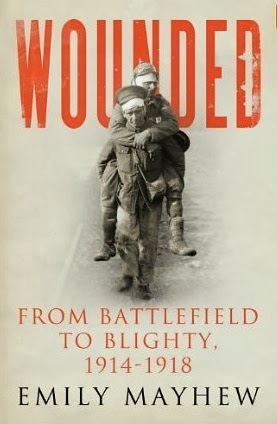
I recently read Emily Mayhew’s book “Wounded” about the British Army’s medical corps during WWI.  I read a poem that a royal army chaplain attached to a field hospital wrote based on what he heard from stretcher bearers attached to his unit.  Reading it brought tears to my eyes.   After finishing it, I felt almost like I’d walked a couple of miles in foot-deep mud, smelling dead bodies, and cringing at the sound of incoming artillery rounds.  Can you imagine how badly a man would have to be injured to require a year’s worth of hospitalization and how hellish an environment he would be in for other men to regard that as an extraordinary bit of good luck?  It is my opinion that anyone who cannot make a rhyme does not qualify as a poet.  About the only bit of explanation this needs is that M.O. stands for medical officer. 

“Easy does it – a bit o’ trench ‘ere
Mind that blinkin’ bit of wire
There’s shell ‘ole on your left there
Lift ‘em up a little ‘igher
Stick it, lad, ye’ll soon be there now
Want best ‘ere for a while?
Let ‘im down then – gently, gently
There you are, lad, that’s the style
Want a drink mate? ‘Ere’s me bottle

Lift ‘is head up for ‘im, Jack
Put my tunic underneath ‘im
‘Ows that chummy?  That’s the tack!
Guess we’d better make a start now
Ready for another spell?
Best be goin’, we won’t ‘urt ye
But ‘e might just start to shell
Are you right, mate? Off we goes then
That well over on the right
Gawd almighty, that’s a near ‘un!
‘Old your end up good and tight
Nigh mind, lad, you’re for blighty
Mind this rotten bit of board
We’ll soon ‘ave ye tucked in bed, lad
‘Opes ye gets to my old ward
No more war for you my ‘earty
This’ll get ye well away
12 good months in dear old blighty
12 good months if you’re a day
M.O. got a bit of something
What’ll stop that blasted pain
Ere’s a rotten bit o’ ground, mate
Lift of ‘igher – up again
Wish ‘ed stop ‘is blasted shellin’
Makes it rotten for the lad
When a feller’s been and got it
It affects ‘im twice as bad
Ow’s it goin’ now then sonny?
‘Ere that narrow bit of trench
Careful, mate, ther’s some dead jerries
Lawd almighty, what a stench!
‘Ere we are now, stretcher case boys
Bring him aht a cup o’ tea

Inasmuch as ye have done it
Ye have done it unto me.”

Emily Mayhew


A Great Jefferson Quote

Thomas Jefferson, the third President of the United States, was the chief draftsman of this country’s Declaration of Independence and is renowned as one of the most brilliant and scholarly chief executives this country has ever had.  If I had to choose one quote of his as my favorite, it would be this: 

“What care I if my neighbor worships one god or twenty?  It neither picks my pocket nor breaks my leg.”